
Core Concepts
Version: 1.1
Last Updated: July 30, 2026
This guide explains how VuduVations processes your data and what to expect from your results.
Table of Contents
1. How Your Data Is Processed
VuduVations processes your input through the first four layers of the MCOS stack. Each layer builds on the previous one, transforming raw content into actionable intelligence. The fifth layer, governance, is not part of an analysis run — it sits over contracts and invoices and is the only layer that can block an action. See Sentinel.
YOUR INPUT (transcript, document, audio, video)
          |
          v
  LAYER 1: INPUT
  Accepts your file or text, auto-detects the format,
  and normalizes it for processing.
          |
          v
  LAYER 2: EXTRACTION
  Pulls out structured data — entities, quotes, facts,
  relationships — directly from your content.
          |
          v
  LAYER 3: ANALYSIS
  Multiple specialized agents examine the extracted
  data from different angles.
          |
          v
  LAYER 4: PROTOCOL
  Applies protocol-specific logic to generate your
  final scores, insights, and recommendations.
          |
          v
    YOUR RESULTS
Why This Matters
Material findings are designed to retain a path back through the layers to the source evidence in your input. The extraction layer establishes source-grounded facts before model interpretation begins, while downstream reasoning and recommendations remain subject to validation and review. If the system says "John is a key person risk", the supporting quotes, facts, and decision path can be inspected.
2. Supported Inputs
You don't need to tell the system what type of file you're uploading — it auto-detects the format and selects the right processing method.
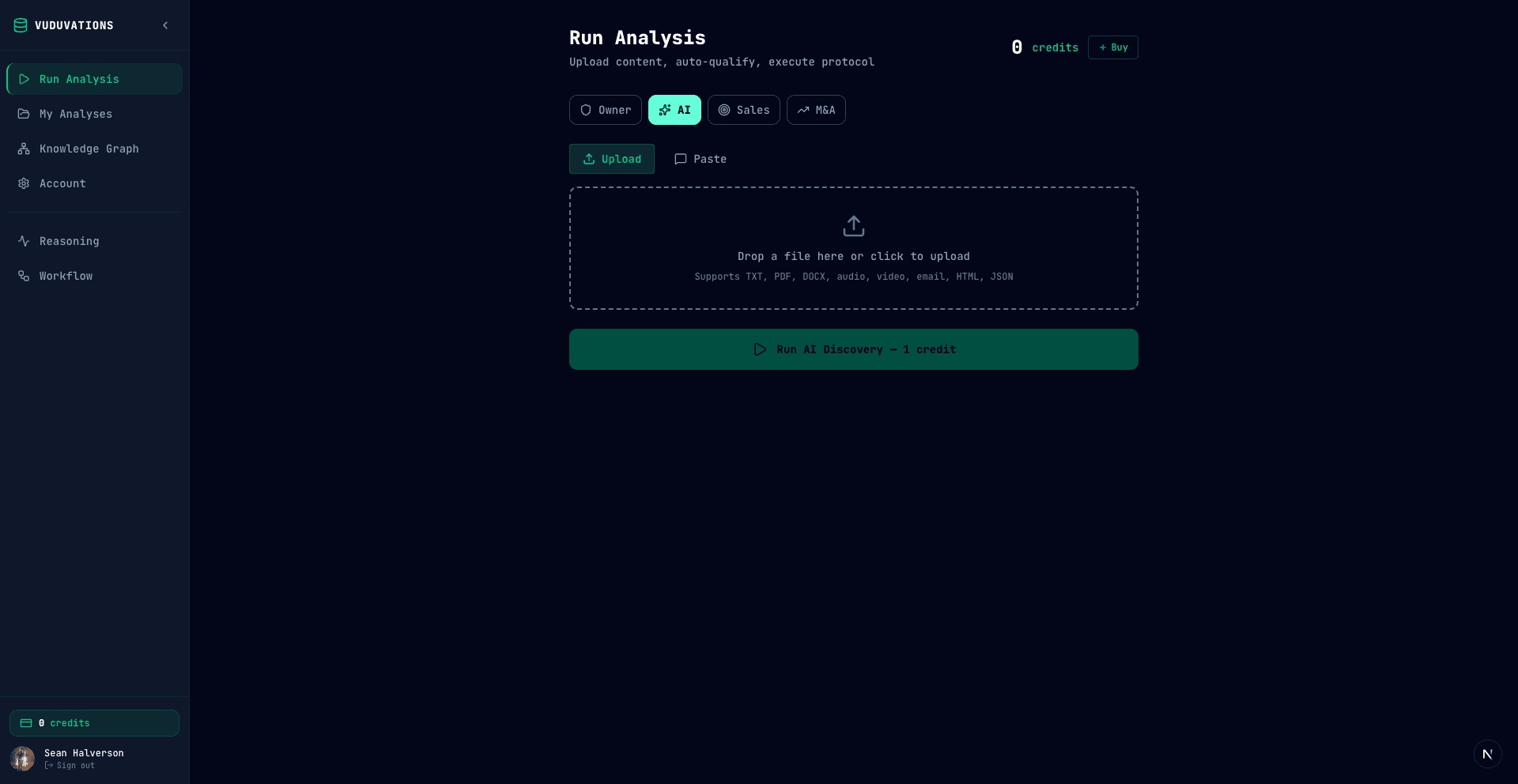
Accepted Formats
| Input Type | Formats | Max Size |
|---|---|---|
| Audio | MP3, WAV, M4A, OGG, FLAC | 50 MB |
| Video | MP4, MOV, WEBM, AVI | 50 MB |
| Documents | PDF, DOCX, TXT, HTML | 10 MB |
| Data Files | JSON, CSV | 10 MB |
| Pasted Text | Plain text | 100+ characters |
Best Practices
| Do This | Avoid This |
|---|---|
| Use clear audio recordings | Background noise, crosstalk |
| Include speaker labels if possible | Unlabeled multi-speaker audio |
| 30-60 minute conversations | Very short (<5 min) or very long (>2 hr) |
| Provide context in document headers | Heavily formatted PDFs with images |
Tip: The richer your input, the richer your results. A 45-minute strategy conversation will produce significantly more insights than a one-page summary.
3. Source-Grounded Extraction
Before any analysis begins, VuduVations extracts the structured data — entities, quotes, facts, relationships — directly from your content. Every figure in your results traces back to a specific line in the source you provided.
The system grounds findings in your source itself. It does not retrieve from a database or vector store you have to build and populate first, and it does not invent numbers to fill gaps. If a figure appears in your results, it appeared in your input.
What This Means For You
| Benefit | Details |
|---|---|
| Source-grounded | Every extracted entity, quote, and fact comes directly from your input |
| Repeatable | Run the same input twice, get consistent extractions |
| Auditable | Every data point links back to the exact source text |
| Controlled extraction | Non-generative extraction avoids filling missing fields with model-generated values; malformed or ambiguous source material can still require validation |
What Gets Extracted
The extraction layer identifies and structures:
This structured foundation gives the downstream analysis a controlled starting point. The AI agents in the next layer work with source-grounded structured data, rather than being asked to discover every consequential fact inside raw text while also reasoning about it.
4. Multi-Agent Analysis
Once your data is extracted, multiple specialized AI agents analyze it simultaneously — each from a different perspective.
How It Works
Think of it as assembling a consulting team. Instead of one generalist reviewing everything, you get specialists who each focus on what they do best:
These agents cross-reference each other's findings. A pattern one agent identifies becomes an input for another agent's risk assessment, which feeds into yet another agent's recommendations.
What You Get
The combined output includes:
| Output | What It Tells You |
|---|---|
| Patterns | Recurring themes and behaviors in your data |
| Risks | Threats ranked by severity (Critical, High, Medium, Low) |
| Opportunities | Areas for improvement ranked by potential impact |
| Recommendations | Prioritized action items with supporting evidence |
| Synthesis | Executive summary tying everything together |
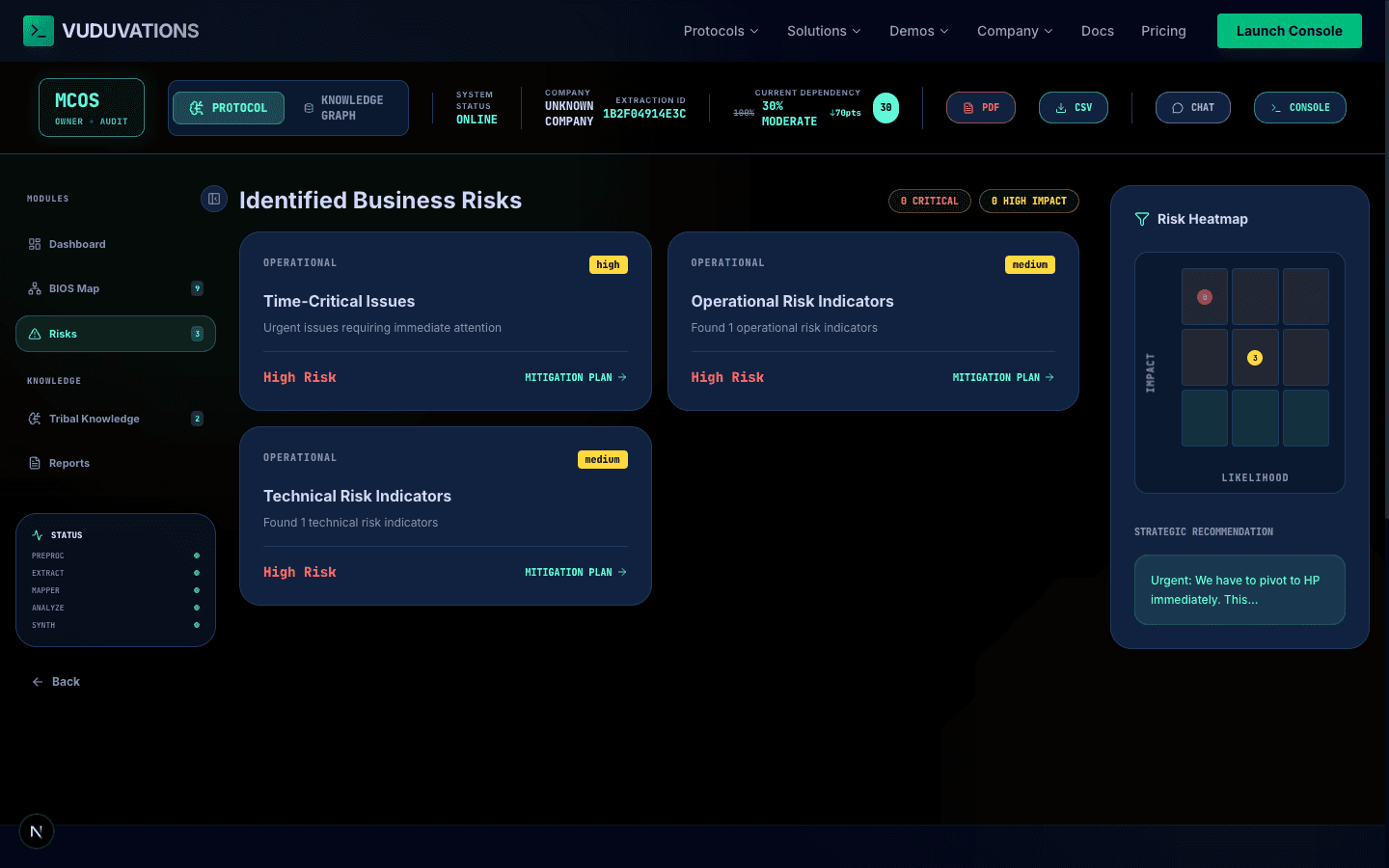
Key difference: A generic single-pass assistant typically returns one synthesized response. MCOS separates extraction, specialized analysis, protocol logic, validation, and governance so each stage has a clearer responsibility and record.
5. Protocol-Specific Intelligence
The final layer applies protocol-specific logic to tailor your results. The same extracted data and agent analysis gets interpreted through a different lens depending on which protocol you run.
Available Protocols
| Protocol | What You Get | Best For |
|---|---|---|
| Key Person Audit | Dependency Summary, Decision Logic Map, Process Ownership, Transition Plan | Operations, HR, succession and M&A teams |
| AI Discovery | AI Readiness Score, grounded use cases, financial model, roadmap | Operations leaders, executives |
| Sales Intel | Deal Health Score, Objection Map, Next Actions | Sales managers, revenue teams |
| M&A Diligence | Deal Risk Score, Go/No-Go Recommendation | M&A teams, investors |
| Workflow Transform | Automation Graph, Friction Points, Process Maps | Process improvement teams |
| Contract Analysis | Obligations, Risk Provisions, Health Score | Legal, procurement, deal teams |
| RFC Quality | Requirement clarity and completeness scoring | Product and engineering teams |
Same Data, Different Insights
Running the same input through different protocols reveals different things:
| What the data shows | Key Person Audit sees | AI Discovery sees |
|---|---|---|
| "John handles all vendor negotiations" | Key person risk | Automation opportunity |
| "Process takes 3 days" | Operational dependency | Efficiency gain potential |
| "No documentation exists" | Succession risk | Knowledge capture opportunity |
Tip: Running the same content through multiple protocols gives you a 360-degree view. Each protocol surfaces insights the others don't prioritize. See the protocol-specific guides for detailed walkthroughs.
6. The Accumulation Effect
Each analysis you run doesn't just produce a standalone report — it builds on everything that came before.
How It Works
When you run multiple analyses, entities are deduplicated across results. If "Acme Corp" appears in five different analyses, it exists as a single entity with five sets of relationships — not five separate copies.
Analysis 1: Key Person Audit
  Finds: "John is critical to operations"

Analysis 2: AI Discovery
  Finds: "Opportunity to automate John's process"
       Links to: Key Person Audit risk finding

Analysis 3: Workflow Transform
  Finds: "John's approval step is the bottleneck"
       Links to: Key Person Audit risk
       Links to: AI Discovery opportunity
Your intelligence gets denser and more connected with every analysis — not just bigger.
Institutional Memory
With Institutional Memory, these connections become a visual knowledge graph you can query, explore, and export. Ask questions like "Show me all risks connected to John" and get instant, evidence-backed answers across all your analyses.
7. Why This Matters For You
Trust Your Results
| Feature | What It Means |
|---|---|
| Evidence trails | Every insight links back to the exact source quote or fact |
| Source-grounded | Material figures are retained with source evidence and calculation context where available |
| Confidence scores | The system tells you how certain it is about each finding |
| Auditability | Full trace from recommendation → analysis → extraction → source |
Get More Over Time
| Feature | What It Means |
|---|---|
| Accumulation | Each analysis builds your knowledge graph |
| Cross-analysis insights | Patterns emerge across multiple conversations |
| Structured exports | PDF, CSV, and graph exports work with your existing systems |
| Defensible decisions | Evidence-backed recommendations you can present to boards, investors, or teams |
Quick Reference
| Layer | What It Does | Key Benefit |
|---|---|---|
| L1 — Input | Accepts and normalizes your data | Supports audio, video, documents, text |
| L2 — Extraction | Pulls out entities, quotes, facts | Grounded in your source, traceable to the quote |
| L3 — Analysis | Multi-agent consulting analysis | Multiple perspectives, cross-referenced |
| L4 — Protocol | Domain-specific scores and insights | Tailored to your use case |
| L5 — Governance | Enforces contract terms before an action executes | The only layer that can block |
Need help? Contact [email protected].