
Key Person Audit
Find critical knowledge dependencies and handover gaps. Keep a proposed handover distinct from demonstrated readiness.
Explore the handover exampleCONSULTING-AS-CODE™ / VUDUVATIONS
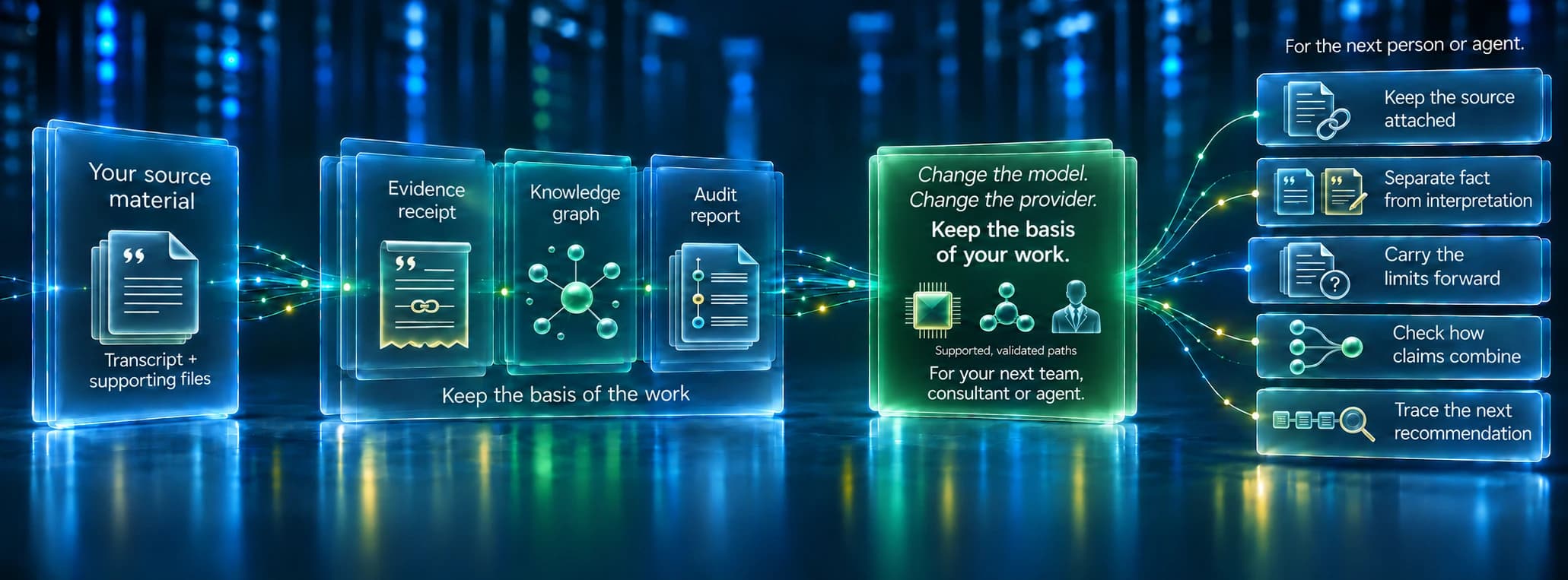
You carry the risk.Keep the evidence behind the answer.
When someone challenges a recommendation, inspect its sources, calculations, qualifications and unresolved questions—even after the model, provider or team changes.
AI workflows built around your business task, with agreed records and review controls.
See how it fits your work.Models, providers and people change.Keep the basis of your work.
EXISTING APPLICATIONS / CUSTOM WORKFLOWS
Our protocols are repeatable workflows for specific business tasks. Start with an existing application, or scope a custom workflow with us.
Find critical knowledge dependencies and handover gaps. Keep a proposed handover distinct from demonstrated readiness.
Explore the handover exampleUnderstand the buyer’s stated needs and a supported next move, with the source and qualifications retained.
Explore the deal exampleStructure AI opportunities, priorities and open questions from the information your business supplies.
Explore AI DiscoveryReview diligence findings with their source support, open questions and saved exports.
Explore M&A DiligenceWe can build a custom workflow around your task, evidence and review rules, with scope and acceptance checks agreed first.
HOW AN ENGAGEMENT WORKS
Agree the business question, the inputs, who reviews the result and the checks needed before use.
Supply an exported meeting transcript and the supporting files needed for the task.
Choose an existing application or develop a custom protocol around your questions, rules and review process.
Review the findings, supporting evidence and open questions. Retain the agreed records for the next person or agent.
THE RECORDS BEHIND THE RESULT
Your business deliverable addresses the agreed question. These supporting records help your team inspect its basis.
Inspect the figures used, their recorded source quotations, calculation inputs and check outcomes within the receipt’s scope.
Explore the available relationships among people, processes, risks and findings in the exported graph.
Review recorded processing steps, checks, results and the cost information available for the analysis.
Keep the agreed evidence, records and handover materials for your business. Software and reuse rights are defined for the engagement.
Trace the source, repeat the arithmetic and see what remains unconfirmed in this fictional staffing example.
One finding, with its source and limits.
Inspect the example · expand for detailSwipe across the image to see both records.

Still unconfirmedActual payroll costs and how much could be saved.
Combined total withheldA separate $210,000 has no stated period and may overlap with staffing cost.
“We have eleven people in order entry. Fully loaded, each of them is about $54,000 a year.”
Keep the original words and context. The speaker describes eleven people in order entry and an approximate fully loaded annual cost per person, including employment costs.
These are figures recorded in a fictional interview. Their source links let a later agent or authorized reviewer inspect what was supplied; they do not independently verify payroll.
Read the finding, inspect its simplified JSON or review the check notes. These MD, JSON and TXT views illustrate the same example; they are not the customer’s Evidence Receipt, Knowledge Graph and Audit Report package.
Interview figures imply about $594,000 per year in staffing cost. That supports investigating the workflow; it does not establish how much could be saved.
SOURCE EXCERPT“We have eleven people in order entry. Fully loaded, each of them is about $54,000 a year.”
The per-person amount is approximate. Actual payroll, achievable savings and possible overlap with a separate cost line remain unconfirmed.
KPA’s graph snapshot is JSON; its full audit and source companion are separate. Neo4j/Cypher tooling depends on the product and access.
Explore KPA exportsKeep the source context, recorded findings, qualifications and open questions alongside the graph. The available files depend on the product and access.
Explore the retained KPA recordKeep the source references, inputs, interpretation, qualifications and recorded refusals together. A later reviewer can inspect that basis without asking a changed model to recreate the original answer.
Having the record does not authorize every new use. Sentinel checks integrity, meaning and current-use authority in workflows configured to enforce those controls.
Try the separate claim-use exampleAUDITABILITY / REPRODUCIBILITY
Keep the saved inputs, original source files and check rules together so another tool can inspect the work.
Calculations can be recomputed; judgments can differ. The next tool must support the exported records and specified checks.
Across platforms: the retained record is separate from the proprietary runtime. A compatible receiver applies its own checks using the required source companion.
Across models: retain the evidence and check rules when comparing model interpretations. Calculations can be recomputed; judgments can differ. Provider choice and model integration remain path-specific.
Read the audit and portability evidenceAgent/system assurance and claim-level controls are complementary; reliability and accountability overlap.
What supports this business conclusion?
Structures inputs, typed evidence, model-assisted analysis, and Layer 4 deliverables.
May this reading support this use now?
Uses Claimlatch’s Evidence Passports to separate integrity, meaning, and current-use authority.
How does the scoped agent/system meet the standard?
Third-party testing and audits of behavior and controls for security, safety, reliability, and related risks.
A reading can quote a clause exactly and still omit an exception or change a trigger. Sentinel checks meaning separately before approval. Dated amendments can supersede a reading; adverse meaning findings can hold reuse. A hold requires a fresh supported check and a separate release. Signed history stays intact.
This comparison implies no AIUC-1 certification, endorsement, or insurance coverage for MCOS or Sentinel. Insurance is separately underwritten.
Offline boundary: signed exports support integrity verification under the supplied trust. Only enforcing consumers see and act on current-use holds.
FROM THE RECORD TO ITS NEXT USE
A budget quotation can be intact and still fail to support the proposed use. Explore the three separate checks in this fictional example.
One source quotation. One proposed use.
MCOS keeps the documented basis inspectable after the run. Sentinel addresses a further question: may this particular interpretation support the agent’s intended use now?
SEPARATE FICTIONAL BUDGET EXAMPLE Explore the checks; this is not a live verification.
“Budget up to $300,000, subject to board approval.”
“An approved $300,000 budget is available.”
Intended use: another agent treats the amount as approved funding.
Does the agent’s quote match? Is the record intact?
Intact in this scenarioFor this fictional scenario, assume the quotation matches the source and the recorded evidence and signatures are intact. This establishes integrity in the example; it does not establish that the budget is approved.
Integrity preserves the connection to the source. Meaning and current-use authority remain separate questions.
A reading that was previously permitted can be held when a later meaning review finds a problem. In workflows that enforce these controls, reuse pauses while the original signed record stays intact.
Pause use of the affected reading. Preserve what was signed and recorded.
Review new meaning evidence. A fresh check does not release the hold by itself.
An explicit release decision is required before the held reading can be used again.
Released readings face integrity, meaning, and current-use checks again at each use.
Illustrative outcomes, separate from the MCOS receiving test above. These checks do not prove a recommendation correct or verify a real budget. Model-based meaning checks support review; they do not replace independent expert validation.
DESIGN / BUILD / GOVERN
Start with one decision, process or knowledge handover. We’ll agree the inputs, domain rules, deliverables, review authority and acceptance checks for a scoped engagement.
THE WORK / THE RECORD / THE NEXT USE
Start with the transcript. MCOS structures the evidence and analysis. Keep the basis after the run, with controls for the next use.
Scroll to explore. Select any area for a closer look.Fictional transcript excerpt · Supplied transcript input; meeting logos do not imply a direct integration.
Shared MCOS foundation. Domain-specific configuration and acceptance checks.
Formats and field coverage vary by protocol. Cypher tooling and additional exports depend on product access and engagement scope.
Follow the source, calculation and limits in the staffing example.
Inspect the worked exampleSpecified checks · Compatible receiver · Required source companion. Recomputed arithmetic does not establish source truth, savings or a correct recommendation.
APPLY THE SHARED FOUNDATION
Explore how the shared foundation can be configured for different business requirements.

Source handling, typed evidence and scoped agent analysis. Domain protocols shape the questions and outputs.
Integrity, meaning and current-use authority stay separate. Claim controls are configured for the intended purpose.
Choose compatible agents and models for the task. Keep the retained record separate from the runtime.
Understand where delivery exceptions accumulate.
Examine documented delays and dependencies. Keep proposed explanations distinct from recorded events.
Agree event coverage, matching periods, duplicate-cost checks and who may approve a proposed operational change.
Agents perform the work. MCOS retains its documented basis. Sentinel governs claim use.
MCOSStructure agent work. Retain its evidence.
SentinelGovern claim use across agent workflows.

Choose a stage or claim check to explore.Blue marks the selected view.
MCOS What the agent’s work rested on
Sentinel Whether a particular claim may be used
Preserve supplied material, speaker turns and source spans before agent interpretation, so later agents can trace the work to its original inputs.
Conceptual view. Human review, approval and intervention depend on the workflow, implemented controls and permissions. MCOS and Sentinel have separate checks and evidence; integration is workflow-specific. Retained records do not make arbitrary agents or models interchangeable.
Typed contracts structure what crosses L1–L4. The supported workflow preserves source references and applies selected checks, including financial checks within their specified scope. A later review inspects the retained record. These checks do not establish the truth of every claim.
Sentinel implements Claimlatch’s reusable profile. Integration and enforcement depend on the implemented workflow.
THE RESEARCH FOUNDATION
Two illustrated technical briefs. Practical examples, mechanisms and their limits.
TECHNICAL BRIEF / NOVEMBER 2026
Keep the Evidence Behind the Answer
Follow the four layers, a worked staffing calculation and the record a later agent can inspect.
Read the MCOS briefPDFTECHNICAL BRIEF / NOVEMBER 2026
Before the Next Agent Acts
Explore integrity, meaning and current-use authority, with an example of holds, rechecks and release.
Read the Sentinel briefPDFInformative briefs with scoped synthetic examples and assistant-operated checks. Universal accuracy and certification are not claimed.
Explore the briefs and operational sovereignty